Video world models are increasingly used to generate training data for robots. DreamGen (Jang et al., 2025) trains robot policies on such synthetic videos and teaches a humanoid 22 new behaviors from teleoperation data of a single pick-and-place task. Its benchmark, DreamGen Bench, rates video models with vision-language judges on whether the robot completes the instructed task and whether the video is physically plausible. This benchmark has people judge the same two properties.We take all 126 public DreamGen Bench inputs, each a head-camera frame of a Fourier GR1 humanoid with a task instruction, and have every model generate one video per input. In pairwise matches, annotators judge instruction following (“Which robot completes the task?”, with the instruction shown) and physics alignment (“Which video contains more glitches?”, the video with fewer glitches winning). The 1,441,905 responses collected across 161,110 such matches are aggregated into ratings with a Bradley–Terry model. General-purpose video models lead both rankings, ahead of every world model built for robots or physical AI that we could run, including the GR1 checkpoint NVIDIA released with DreamGen. The details cover the setup and the comparison with DreamGen Bench; the methodology covers matchmaking and score estimation.
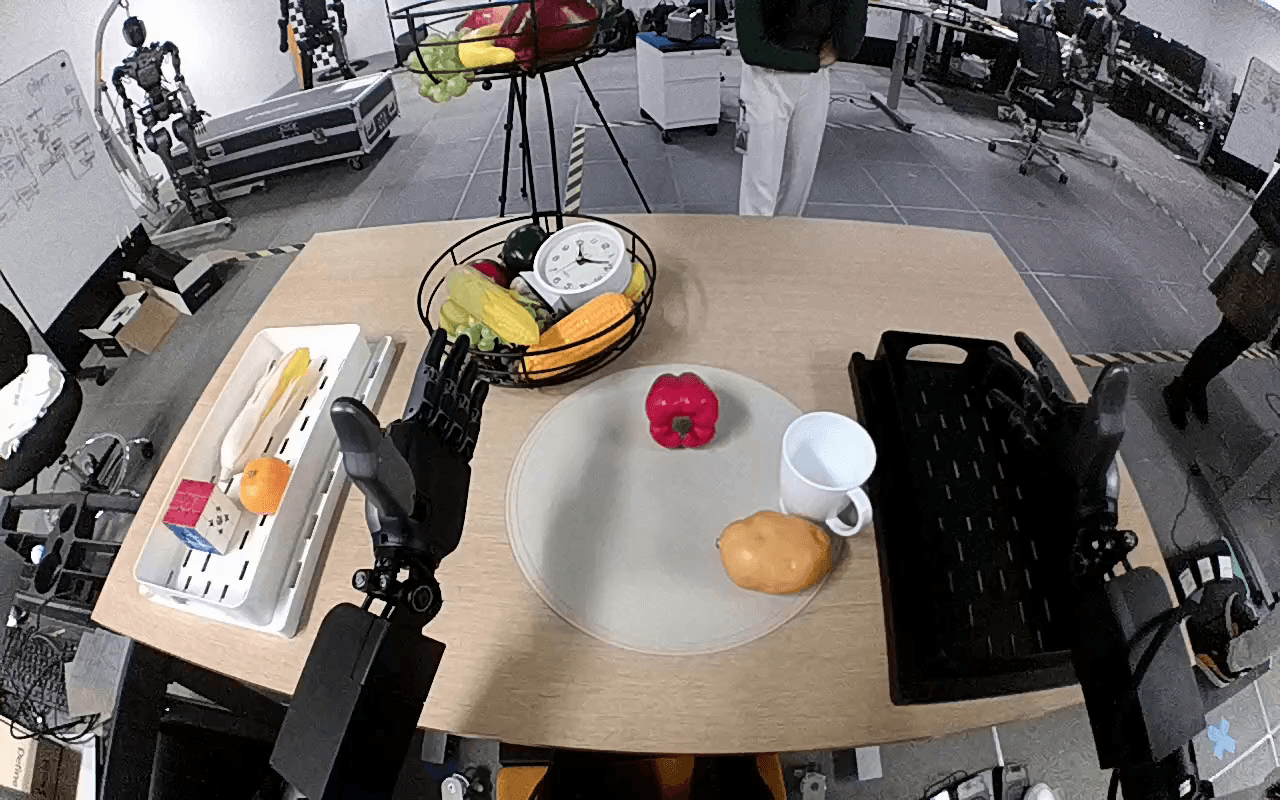 Start frameInstruction: “Use the right hand to pick up white mug from table mat to dark wooden tray”
Full protocol in the global methodology.
We use crowd intelligence to deliver real, diverse human feedback at scale for model evaluation and post-training.
